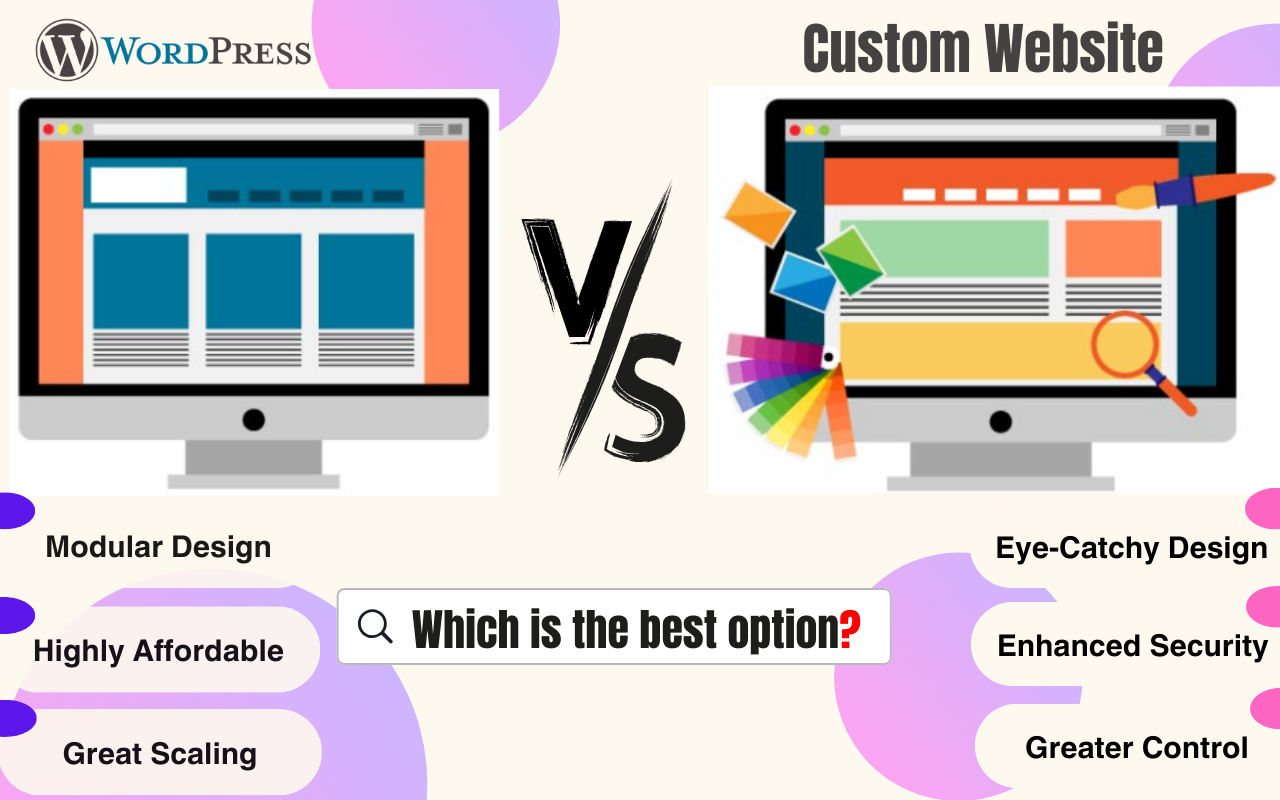
If you've ever asked a web developer "should I go with WordPress or a custom-built site?" — you've probably received one of two answers:
The WordPress developer says WordPress, obviously. The custom developer says custom, obviously.
Neither is lying. Both are biased. And neither answer is particularly useful for a Nigerian business owner trying to make a smart, informed decision about something that will cost real money and shape their online presence for years.
This guide is different. We're going to break down both options honestly — what they cost, what they're good for, where they fall short, and crucially, which type of business should choose which option in the Nigerian market specifically.
By the end, you'll know exactly which path is right for you — and why.
First, Let's Be Clear About What These Terms Actually Mean
WordPress is a Content Management System — a piece of software that lets you build and manage a website without writing code from scratch. It's free to download, powers roughly 43% of all websites globally, and can be extended with thousands of plugins and themes. When people say "WordPress website," they usually mean a site built on WordPress using a premium theme, customised with your branding, content, and plugins.
A custom-built website means a developer writes your website's code from scratch — or builds it using a modern development framework like React, Next.js, or Laravel — specifically designed around your business needs. There are no off-the-shelf templates involved. Every element is purpose-built.
Both are legitimate approaches. The question is which one matches your business's actual situation.
The 6 Key Factors to Compare
1. Cost — What You Actually Pay
This is usually the first question, and it's where the biggest misconceptions live.
WordPress:
A professionally built WordPress site in Nigeria typically costs between ₦150,000 and ₦600,000 for a standard business website, depending on complexity, the number of pages, and the developer or agency involved. Hosting runs ₦24,000 to ₦80,000 per year. Premium themes cost ₦15,000 to ₦60,000 as a one-time fee. Plugins add recurring costs depending on what you need.
The lower entry cost is real — but it comes with important caveats. Many Nigerian businesses have been quoted ₦50,000 to ₦100,000 for a "website" and received a pre-built theme with a logo swapped in, a phone number updated, and services listed in default template sections. That is not a professionally built WordPress site. It is a template dressed up as one — and it will not load fast, rank on Google, or convert visitors into customers. Budget for quality, not just for WordPress.
Custom-built:
A properly built custom website in Nigeria starts at ₦500,000 for something relatively straightforward and can reach ₦3,000,000 or more for a feature-rich platform. Web applications and SaaS tools built on custom code can cost significantly more. The higher price reflects more development hours, more specialised skills, and more time to build and test.
Over a 3-year period, the cost comparison shifts in an interesting way:
| Item | WordPress (3 years) | Custom (3 years) |
|---|---|---|
| Initial build | ₦250,000 – ₦600,000 | ₦600,000 – ₦3,000,000+ |
| Hosting | ₦72,000 – ₦240,000 | ₦72,000 – ₦240,000 |
| Premium plugins/year | ₦30,000 – ₦150,000 | None (built-in) |
| Maintenance & updates | ₦60,000 – ₦200,000 | ₦100,000 – ₦400,000 |
| Total (estimate) | ₦412,000 – ₦1,190,000 | ₦772,000 – ₦3,640,000+ |
For most small and medium Nigerian businesses, WordPress delivers strong value at a significantly lower total investment. Custom makes sense when your business genuinely needs what WordPress cannot provide — which we will get to shortly.
2. Speed to Launch — How Quickly You Can Go Live
Time matters. Every month without a proper online presence is a month of potential customers going to competitors.
WordPress: A professionally built WordPress site can typically be launched in 2–6 weeks, depending on the scope and how quickly the client provides content and feedback. The ecosystem of pre-built themes and plugins means a developer isn't building common elements from scratch.
Custom-built: A custom website takes longer — typically 6 weeks to 6 months depending on complexity. A custom eCommerce platform with specific integrations, a booking system, or a unique workflow can take even longer. Every feature has to be architected, built, and tested individually.
The verdict for most Nigerian businesses: If you need to get online within a month or two — and most do — WordPress wins on speed. Custom development is appropriate when you have the runway to build something right, not fast.
3. Flexibility and Features — What Each Can Actually Do
WordPress:
WordPress handles the overwhelming majority of what Nigerian businesses actually need from a website:
- Standard business websites (any size)
- Blogs and content-driven sites
- eCommerce stores (via WooCommerce, Nigeria's most-used eCommerce platform)
- Portfolio and agency sites
- School and institution websites
- NGO and charity websites
- Event and booking sites
- Membership platforms
- News and media sites
With the right plugins, WordPress can integrate Paystack and Flutterwave natively, connect to WhatsApp, manage appointments, run a full online store, and do almost anything a standard Nigerian business website needs to do.
Where WordPress hits its limits:
WordPress starts to struggle when your website is essentially a software product rather than a content site. Highly specific functionality — a custom marketplace with multi-vendor payouts, a logistics platform with real-time tracking, a fintech tool with complex transaction logic, a school management system with specific Nigerian curriculum workflows — is either impossible or impractical to build reliably with WordPress.
Custom-built:
Custom development has no ceiling on functionality. If you can describe what you want the software to do, a skilled developer can build it. Complex business logic, unique integrations with other Nigerian systems, proprietary workflows, and features that don't exist in the WordPress plugin ecosystem — all of this is the territory of custom development.
The honest reality is that most Nigerian SMEs never reach the point where they actually need this level of flexibility. The businesses that genuinely need custom development are building products, not just web presences.
4. Performance and Speed — How Fast the Site Loads
Website speed matters enormously in Nigeria, where many users browse on mobile data that can be inconsistent. A slow site loses Nigerian visitors fast.
WordPress:
WordPress performance depends heavily on how it's built and where it's hosted. A poorly set up WordPress site — loaded with too many plugins, sitting on cheap shared hosting, with uncompressed images — can be painfully slow. A well-built WordPress site, on quality hosting with proper caching, image optimisation, and a lean plugin setup, loads fast and scores well on Google's Core Web Vitals.
The key phrase is "well-built." The difference between a fast and a slow WordPress site is not the platform — it is the quality of the developer and the hosting. This is worth asking about specifically when getting quotes.
Custom-built:
Custom sites have a natural performance advantage because they contain only the code they need — no plugin overhead, no theme bloat, no unnecessary database queries. A well-built custom site will almost always be leaner and faster than a WordPress equivalent with the same features.
However, a poorly written custom site can also be slow and buggy. Performance is ultimately about the quality of the code, not just the platform.
For most Nigerian businesses: A well-built WordPress site on quality hosting performs well enough to rank on Google and serve customers without frustration. The performance advantage of custom becomes meaningful at scale — high-traffic platforms, real-time applications, complex data processing.
5. Security — Staying Safe in a Fraud-Conscious Market
Security is not an abstract technical concern in Nigeria — it directly affects whether customers trust your website enough to pay you.
WordPress:
Because WordPress powers 43% of the internet, it is the number one target for hackers worldwide. WordPress sites that are neglected — not updated regularly, running outdated plugins, on poor-quality hosting — are frequently compromised. Nigerian business owners have experienced defaced websites, injected spam content, and stolen customer data because of poorly maintained WordPress installations.
However, a WordPress site that is properly maintained — core, theme, and plugins updated regularly, a security plugin installed, good hosting with server-side protection, strong passwords, and regular backups — is robustly secure. The security risk of WordPress is real but manageable with discipline.
Custom-built:
Custom sites have a smaller attack surface because they don't share vulnerabilities with the millions of other sites running the same WordPress codebase. A custom site's security depends entirely on how the developer has written and structured the code — which can be excellent or disastrous depending on the developer's skill.
The verdict: Both can be secure. Both can be insecure. What determines security is maintenance discipline and developer quality — not platform choice alone. Any website without SSL, regular backups, and monitored uptime is a risk, regardless of how it was built.
6. Ease of Management — Can You Update It Yourself?
After your website launches, you will need to update it — add services, change prices, publish blog posts, swap photos. How easy is this without calling your developer every time?
WordPress:
This is WordPress's strongest advantage for non-technical Nigerian business owners. The WordPress dashboard is designed for content management by non-developers. Updating a page, adding a blog post, uploading new photos, changing your opening hours — all of this can be done by anyone who can use Microsoft Word or Google Docs. No coding required.
This matters practically in the Nigerian market where many business owners cannot afford ongoing developer retainers for basic content changes.
Custom-built:
A custom site may or may not include an easy-to-use content management interface — it depends entirely on whether the developer built one into the project. Some custom sites include a beautifully tailored admin panel that's easier than WordPress. Many do not include a good admin interface at all, leaving the business owner dependent on the developer for every small change.
If you're getting a custom site built, ask specifically: "How will I update the content after launch? Will I be able to do it myself, or will I need your help?" The answer will tell you a lot.
So Which Should You Choose? The Honest Framework
Rather than giving you a blanket recommendation, here is the decision framework that actually applies to Nigerian businesses in 2026.
Choose WordPress if:
You need a professional business website, blog, or portfolio This is WordPress's home territory. A law firm, restaurant, school, church, NGO, consulting agency, freelancer, or service business with a standard web presence need — WordPress is the right choice, and it will serve you extremely well.
Your eCommerce needs are straightforward If you're selling products online with standard catalogue, cart, and checkout functionality — WooCommerce (built on WordPress) is Nigeria's most widely used eCommerce solution and integrates natively with Paystack and Flutterwave. It handles the vast majority of Nigerian online stores without strain.
You want to launch within 4–8 weeks WordPress allows a skilled developer to build and deploy a professional site significantly faster than a custom build.
Your initial budget is under ₦600,000 A quality WordPress build is achievable at this budget. A quality custom build typically is not.
You want to manage your own content If you plan to update your site regularly — prices, services, blog posts, events — WordPress gives you the tools to do this without technical help.
You want a larger talent pool for future support WordPress developers are significantly more available in Nigeria than custom framework specialists. Finding someone to maintain, update, or expand your WordPress site after launch is much easier than finding someone familiar with a bespoke codebase.
Choose Custom Development if:
Your website IS your product If you're building a platform — a marketplace, a booking system, a fintech tool, a SaaS application, a school management system, a logistics platform — you are building software, not a website. Custom development is the appropriate foundation.
You need specific functionality that WordPress plugins cannot reliably deliver Multi-vendor payouts with complex commission logic, real-time inventory across multiple warehouses, custom ERP integration, proprietary algorithms, specific Nigerian regulatory compliance systems — these are custom territory.
You expect very high traffic at launch If your platform needs to handle thousands of concurrent users from day one — a national competition, a major event, a high-volume marketplace — custom architecture built for that load is more appropriate than WordPress optimised under pressure.
You have the budget and the runway Custom development costs more and takes longer. If your business stage and budget genuinely support this, and your requirements justify it, custom is a powerful investment. If you're stretching to afford it and compromising on quality to do so, you'll likely rebuild in 18 months.
Your business has specific security or data requirements Regulated industries — finance, health, legal — with specific data handling, privacy, or compliance requirements often benefit from custom architecture designed around those requirements from the ground up.
The Most Common Mistake Nigerian Business Owners Make
The most expensive mistake in this decision is not choosing the wrong platform — it is choosing the right platform and then hiring the wrong developer to build on it.
A poorly built WordPress site on cheap hosting with 40 unnecessary plugins is slower, less secure, and less effective than a well-built WordPress site on quality hosting with a lean, purposeful setup. Similarly, a custom site written by an inexperienced developer can be harder to maintain, less secure, and more expensive to fix than a good WordPress build.
The platform is the car. The developer is the driver. Both matter.
Before you sign any contract, ask your developer:
- Can I see examples of similar websites you've built?
- Can I speak with a past client?
- What hosting do you recommend and why?
- Who owns the hosting account after launch — me or you?
- How will I update the website content myself?
- What's included in maintenance after launch, and what does it cost?
- What happens if something breaks after you've been paid?
The answers to these questions will tell you more about what you're buying than any platform debate.
The Simple Decision Checklist
Use this to guide your final decision:
| Question | If YES → |
|---|---|
| Do I need a standard business site, blog, portfolio, or basic store? | WordPress |
| Is my initial budget under ₦600,000? | WordPress |
| Do I need to launch within 2 months? | WordPress |
| Do I want to update my own content without a developer? | WordPress |
| Am I building a platform, marketplace, or SaaS tool? | Custom |
| Does my site need features no plugin can reliably deliver? | Custom |
| Is my budget above ₦1,000,000 and timeline flexible? | Custom |
| Will the website itself be the core of my business product? | Custom |
If your answers point to WordPress — great. Most Nigerian businesses land here, and there is absolutely no shame in it. WordPress, built properly by a skilled developer on quality hosting, is a professional, scalable, long-term solution.
If your answers point to custom — plan carefully, budget properly, hire the best developer you can afford, and build in phases rather than trying to build everything at once.
The Bottom Line
For approximately 85% of Nigerian businesses — the SMEs, the service providers, the growing eCommerce brands, the schools and churches and agencies — WordPress is the right choice. It's faster, more affordable, more maintainable, and more supported by the available developer talent in Nigeria.
Custom development is not "better" — it's different. It's the right tool for a specific type of project that most Nigerian businesses haven't reached yet.
The business that will waste the most money is the one that chooses custom development to "look more serious" when a well-built WordPress site would have served them perfectly — or the one that chooses WordPress for a complex platform that genuinely needs custom architecture.
Know your business. Know your budget. Know what you actually need to grow.
That's the right answer.
Not Sure Which One You Need?
We work with Nigerian businesses to recommend the right platform for their specific goals — not the platform that earns us the most on this project. If you'd like an honest assessment of what your business actually needs, get in touch here and we'll give you a straight answer.
Written by Peterman — Web Developer in Nigeria. Building websites on the right platform, for the right reasons. Questions? Drop them in the comments or send a WhatsApp.
Tags: WordPress vs custom website Nigeria, custom website development Nigeria, WordPress Nigeria 2026, which website platform Nigeria, web development Nigeria comparison, WooCommerce Nigeria, custom web app Nigeria