Here is something most Nigerian business owners do not know about their own website.
After your homepage, the page visitors click most often is your About Us page. Your About Us page is one of the first pages you'll want to prioritise when building your business website, second only to your homepage in importance.
Think about what that means. Before a potential client contacts you, before they request a quote, before they hand over money — they go to your About page. They want to answer one fundamental question: "Who am I actually dealing with?"
And here is the problem. The About page is the single most-wasted page on the majority of Nigerian business websites. It is where business owners write three paragraphs of hollow corporate language — "We are committed to excellence and dedicated to providing quality service to our esteemed customers" — that says absolutely nothing, builds zero trust, and gives the visitor no reason to choose you over anyone else.
In a market like Nigeria, where trust is fragile and hard-won, a weak About page is not a missed opportunity. It is an active liability. A visitor who arrives at your About page hoping to feel confident about you — and instead finds generic, faceless corporate-speak — leaves more uncertain than when they arrived.
This guide shows you exactly how to write an About Us page that does the opposite: one that takes a curious, cautious Nigerian visitor and turns them into a confident, ready-to-contact client.
Why the About Page Matters More in Nigeria Than Almost Anywhere
In every market, the About page builds trust. In Nigeria, it does something more specific and more urgent: it answers the fear that sits behind every online transaction.
Nigerian buyers carry a justified caution into every online interaction. Years of exposure to scams, ghost vendors, and businesses that collected money and disappeared have trained Nigerian consumers to ask, before anything else: Is this a real, legitimate, accountable business run by real people I can trust?
Your About page is where that question gets answered — or not.
A strong About page provides the evidence that calms that fear: real faces, real names, a real story, real credentials, real proof of legitimacy. A weak About page — anonymous, faceless, generic — confirms the fear. It looks exactly like what a fly-by-night operation would put up: vague claims, no people, no specifics, nothing verifiable.
This is why the same About page strategy that "works" for a business in London or New York is insufficient for the Nigerian market. In lower-trust markets, the About page has to work harder. It has to do more to prove legitimacy. The bar is higher — and the businesses that clear it stand out dramatically from competitors who have not understood this.
The 8 Things Every Nigerian Business About Page Must Have
Let me walk through the specific elements that turn an About page from a wasted formality into a genuine client-winning asset.
1. A Real Photo of the Real People
This is the single most important element, and the one most commonly missing from Nigerian business About pages.
Putting a face to your brand helps to humanise it, communicate your company culture, and shine a light on the people who power your business. People want to connect with other people. That's easy to forget when writing a corporate website.
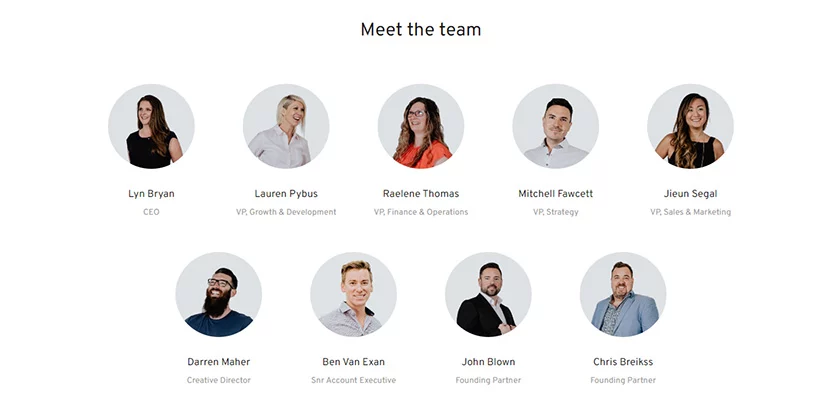
A real, professional photo of you — the founder — or your team is the most powerful trust signal you can put on your About page. Not a logo. Not a stock photo of a smiling model in a suit. Not an illustration. A real photograph of the real human being or people behind the business.
In the Nigerian market specifically, this matters enormously. A visitor who can see the face of the person they would be doing business with feels dramatically more confident than one looking at an anonymous brand. The face says: I am a real person. I am accountable. I am not hiding.
What to do:
- Include a clear, professional, well-lit photo of yourself (if you are a solo business) or your team
- If you have a team, show each person with their name and role
- The photos should look real and approachable, not stiff or corporate. Authentic beats polished — a genuine, warm photo outperforms an over-produced one
- If you cannot afford a professional photographer, even a good smartphone photo in good natural light, against a clean background, is far better than no photo at all
2. Your Genuine Story — Why You Do This
After the photo, your story is what creates connection. Not your company's "mission to deliver excellence" — your actual story. Why did you start this business? What problem did you set out to solve? What do you genuinely care about in your work?
The most effective About pages are written from a storytelling perspective rather than using generic corporate language. Anecdotes put a human face on what might otherwise be a sales pitch or boring, impersonal page written in generic corporate-speak.
A Nigerian web developer's story might be: "I started building websites after watching too many talented Nigerian business owners lose customers to competitors simply because they had no real online presence. I saw brilliant fashion designers stuck in Instagram DMs, skilled caterers invisible on Google, and serious businesses being judged as amateur because their website looked like an afterthought. I knew I could fix that — and I have been doing it ever since."
That story tells the visitor three things at once: what you do, why you care, and that you understand their specific situation. It is infinitely more powerful than "We are a leading web development company committed to excellence."
What to do:
- Write your real origin story in plain, conversational language
- Focus on the "why" — the problem you saw, the change you wanted to make
- Speak in the first person ("I" or "we"), not the detached third person
- Keep it human, honest, and specific to your actual experience
3. Proof of Legitimacy — Especially Your CAC Registration
This is a Nigeria-specific trust element that most businesses overlook entirely — and it is one of the most powerful.
Displaying your CAC registration number on your About page tells Nigerian visitors something important: this business is legally registered, traceable, and accountable. In a market where ghost vendors and unregistered operators are a real concern, a visible CAC registration is a strong, specific, verifiable trust signal.
Alongside your CAC number, include other proof-of-legitimacy elements:
- Your physical business address (even a registered address if you work from home)
- Your years in operation ("Serving Nigerian businesses since 2019")
- Any professional memberships, certifications, or partnerships
- Your real, professional contact details — phone, WhatsApp, and a business email (not Gmail)
These elements work together to establish that you are a genuine, established, accountable business — which is precisely the reassurance a cautious Nigerian buyer is looking for.
4. Numbers That Prove Your Impact
Numbers give you credibility, especially if you're illustrating progress you've made as a business. Consider the stats you can use on your About Us page as a way to quantify your impact.
Specific numbers are far more persuasive than vague claims. "We have helped many businesses" means nothing. "We have built over 80 websites for Nigerian businesses across 12 states since 2020" is concrete, credible, and impressive.
Numbers you might include:
- Number of clients served or projects completed
- Years in business
- Measurable results you have delivered ("Our clients have collectively generated over ₦200 million in online sales")
- Geographic reach ("Serving businesses in Lagos, Abuja, Port Harcourt, and beyond")
- Any awards, recognitions, or notable milestones
Even if your numbers are modest because you are early in your journey, specificity builds more trust than vagueness. "12 happy clients in our first year" is more believable and more trustworthy than "numerous satisfied customers."
5. Social Proof — Testimonials and Recognition
After sharing your story, back it up with proof. Highlight testimonials, happy clients, or media mentions. These build trust and show visitors you know your stuff.
Your About page should include at least one or two strong testimonials — ideally with the client's full name, photo, business, and a specific result. As covered in the guide on how to make Nigerian customers trust your business website, specific, verifiable testimonials are dramatically more powerful than anonymous praise.
A testimonial on your About page might read: "Peterman built our restaurant website and within three months we were getting bookings from Google every week — customers we would never have reached otherwise." — Chidi Okonkwo, Owner, Lagos Island Grill
If you have been featured anywhere, mentioned in any publication, or recognised in any way — include it. Media mentions and third-party recognition carry significant trust weight because they represent external validation, not just your own claims about yourself.
6. A Clear Statement of What You Do and Who You Serve
While your About page is primarily about trust and connection, it should also clearly restate what you do and who you serve. Add a quick summary of your current services even if they're listed elsewhere. It makes it easier for visitors to understand what you do and why it matters.
A visitor who lands on your About page from a Google search may not have seen your services page yet. A brief, clear statement of your core offering — "We design and build fast, professional websites for Nigerian small and medium businesses" — ensures that even an About-page-first visitor understands exactly what you offer.
Be specific about who you serve, too. "We work with Nigerian SMEs, particularly service businesses, eCommerce brands, and professional firms across Lagos and Abuja" helps the right visitor immediately recognise themselves as your ideal client.
7. Your Values — But Shown, Not Stated
Every business About page wants to communicate its values. The mistake most Nigerian businesses make is stating values as empty adjectives: "Our values are integrity, excellence, and customer satisfaction."
That language is so overused that it has become invisible. It builds no trust because every business — including the dishonest ones — claims exactly the same things.
Instead, show your values through specifics. Rather than claiming "we value transparency," demonstrate it: "We give every client a clear, written quote before any work begins — no hidden costs, no surprise charges." Rather than claiming "we value quality," demonstrate it: "Every website we build is tested on real Nigerian mobile networks before launch, because we know that is how your customers will see it."
Shown values are believable. Stated values are noise. The difference is the difference between a page that builds trust and a page that gets skimmed and forgotten.
8. A Clear Call to Action
Every About Us page should guide visitors toward the next step. This is where most Nigerian business About pages simply stop — the story ends, and the visitor is left with nowhere to go.
After you have introduced yourself, told your story, proven your legitimacy, and built trust — tell the visitor exactly what to do next. The whole point of the page is to move an interested, now-more-confident visitor toward becoming a client.
Strong About page CTAs:
- "Ready to work together? [Get in touch on WhatsApp]"
- "See what we've built for businesses like yours — [view our portfolio]"
- "Let's discuss your project. [Contact us here] and we'll reply within 24 hours."
The CTA should feel like the natural next step after building trust — an invitation, not a hard sell. And given that WhatsApp is where Nigerian sales actually close, making your primary About page CTA a WhatsApp link is often the highest-converting choice.
The Nigerian Business About Page Template
Here is a structure you can adapt directly. Fill in the bracketed sections with your specifics:
[Section 1 — Headline + Founder Photo] A warm, human headline with a real photo. Not "About Us" — something like: "Hi, I'm [Name] — and I help Nigerian businesses win online."
[Section 2 — The Story] [2-3 short paragraphs telling your genuine origin story. Why you started. What problem you saw. What you care about. Written in first person, conversational tone.]
[Section 3 — What We Do] [A brief, clear statement of your services and who you serve. "We design and build [your service] for [your specific audience] across [your area]."]
[Section 4 — The Numbers] [Your impact in specific figures. Projects completed, years in business, results delivered, geographic reach.]
[Section 5 — Why Businesses Choose Us] [3-4 demonstrated values — shown through specifics, not stated as adjectives.]
[Section 6 — Social Proof] [1-2 strong testimonials with full names, photos, and specific results. Any media mentions or recognition.]
[Section 7 — Proof of Legitimacy] [CAC registration number, physical address, professional contact details, years in operation.]
[Section 8 — The Invitation] [A clear, warm CTA. "Ready to get started? Let's talk on WhatsApp" with a clickable link.]
The Mistakes That Kill Nigerian Business About Pages
Avoid these common failures:
Mistake 1: Generic corporate-speak "We are committed to providing quality services to our esteemed customers and exceeding expectations through excellence." This says nothing, proves nothing, and builds no trust. Delete it entirely and replace it with your real story in plain language.
Mistake 2: No human faces An About page with no photo of a real person is an About page that fails its single most important job. If there is one thing you take from this article, let it be this: put your real face on your About page.
Mistake 3: Writing about yourself instead of your customer While the page is "about us," the best About pages connect everything back to the customer. Instead of only listing what you have achieved, frame it in terms of what it means for the client. "10 years of experience" becomes "10 years of experience means we have already solved the problem you are facing."
Mistake 4: Making it too long Nigerian visitors are mostly on mobile, often on data, frequently in a hurry. A wall of text gets skimmed and abandoned. Keep your story tight. Use short paragraphs, clear sections, and visual breaks. Remember that your site must work perfectly on phones — and a long, dense About page is especially punishing on a small screen.
Mistake 5: No call to action Building all that trust and then giving the visitor nowhere to go is a wasted opportunity. Always end with a clear next step.
Mistake 6: Hiding it or neglecting it The About page is too important to be an afterthought thrown together at the end of building your website. It deserves real thought, real photos, and real care — because it is doing real work in converting your visitors into clients.
How Your About Page Helps You Rank on Google Too
There is an SEO dimension to your About page that most Nigerian businesses miss entirely.
A well-written About page is an opportunity to naturally include keywords that help you rank on Google in Nigeria — your location, your services, and your area of expertise, woven naturally into your story.
A web developer's About page that naturally mentions "web developer in Lagos," "websites for Nigerian businesses," and the specific cities and services served, sends relevance signals to Google while also building trust with human visitors. Your CAC registration, physical address, and consistent business name on the About page also reinforce the NAP (Name, Address, Phone) consistency that strengthens your local SEO.
So a great About page does double duty: it converts the visitors you already have, and it helps you attract new visitors through Google. Write it for humans first — but write it with awareness of the search terms your ideal clients use.
A Real Before-and-After
To make this concrete, here is the transformation a typical Nigerian business About page should undergo.
Before (the version most Nigerian businesses have):
"About Us. [Business Name] is a leading provider of web design services in Nigeria. We are committed to delivering excellent and quality services to our esteemed clients. Our mission is to be the best in the industry. With our team of experienced professionals, we provide top-notch solutions tailored to meet your needs. Contact us today."
This is faceless, generic, unverifiable, and forgettable. It could describe any business. It builds no trust.
After (the version that wins clients):
"Hi, I'm [Name]. [Photo] I build websites for Nigerian businesses that are tired of losing customers to competitors who simply show up better online.
I started [Business Name] in 2020 after watching brilliant Lagos business owners — caterers, designers, consultants — stuck invisible on the internet while less talented competitors won the customers, simply because they had a proper website and a presence on Google.
Since then, I have built over 60 websites for businesses across Lagos, Abuja, and Port Harcourt — fast, mobile-first, conversion-focused sites that turn visitors into paying clients.
'[Name] built our store and we made ₦2.1 million in our first two months.' — Adaeze N., BeautyNG Lagos
Every project starts with a clear written quote — no hidden costs. Every site is tested on real Nigerian mobile networks before launch. And every client gets a website they actually own.
[Business Name] | RC: [CAC number] | Lagos, Nigeria
Ready to stop losing customers online? [Let's talk on WhatsApp →]"
The second version has a face, a real story, specific numbers, a verifiable testimonial, proof of legitimacy, demonstrated values, and a clear call to action. It builds trust in seconds. It wins clients.
Your About Page Action Checklist
Before you rewrite your About page, gather these elements:
- A real, professional photo of yourself or your team
- Your genuine origin story written in plain, first-person language
- Your specific impact numbers (projects, years, results, reach)
- 1-2 strong testimonials with full names, photos, and specific results
- Your CAC registration number and physical address
- 3-4 demonstrated values (shown through specifics, not stated)
- A clear summary of what you do and who you serve
- A strong call to action — ideally a WhatsApp link
- Relevant keywords naturally woven in (your location + services)
- Everything checked on a mobile phone for readability
The Bottom Line
Your About Us page is not a formality. It is one of the highest-impact pages on your entire website — the page where curious visitors decide whether they trust you enough to become clients.
In Nigeria, where that trust decision carries extra weight, a great About page is one of the clearest competitive advantages available to your business. Most of your competitors have weak, faceless, generic About pages. Yours does not have to.
Put your real face on it. Tell your real story. Prove you are real and legitimate. Show what you have achieved. And invite the visitor to take the next step.
Do that, and your About page stops being a forgotten formality — and starts being one of your best salespeople, working around the clock to turn visitors into clients.
Need a Website With an About Page That Actually Converts?
A great About page is part of a great website — and building websites that win Nigerian businesses real clients is exactly what we do at Peterman Web Design. From your homepage to your About page to your WhatsApp integration, every element is built to convert.
If you want a professionally designed website with an About page that builds genuine trust, get in touch here and let's talk about your business.
Want to see how we've helped other Nigerian businesses? View our portfolio → or read about 10 Nigerian businesses that grew after building a proper website.
Written by Peterman — Web Developer in Lagos, Nigeria. Helping Nigerian businesses build websites that win real clients. Questions about your About page or your website? Drop them in the comments or send a WhatsApp.
Tags: how to write About Us page Nigeria, About Us page Nigerian business, About page that wins clients, Nigerian business website trust, About Us page examples Nigeria, website About page 2026, Nigerian business About page template